lcf-strain-life
An AI-agent-native toolkit for low cycle fatigue strain-life analysis. A Python library and an MCP server that take strain-controlled fatigue test data, reduce it cycle by cycle, fit the standard models, predict life, and persist every result for recall. Every capability is callable by a human or by an AI agent through the same service layer.
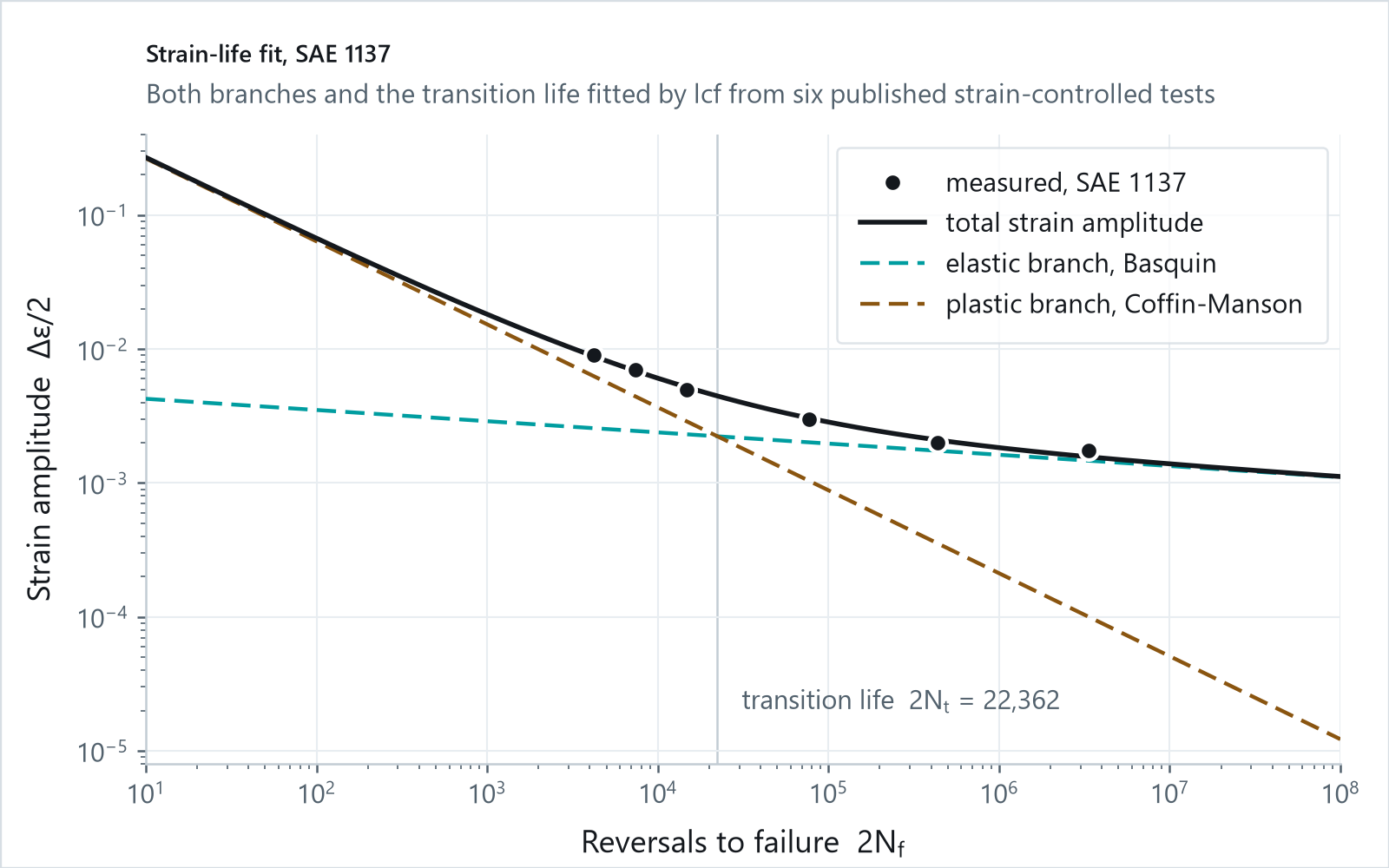
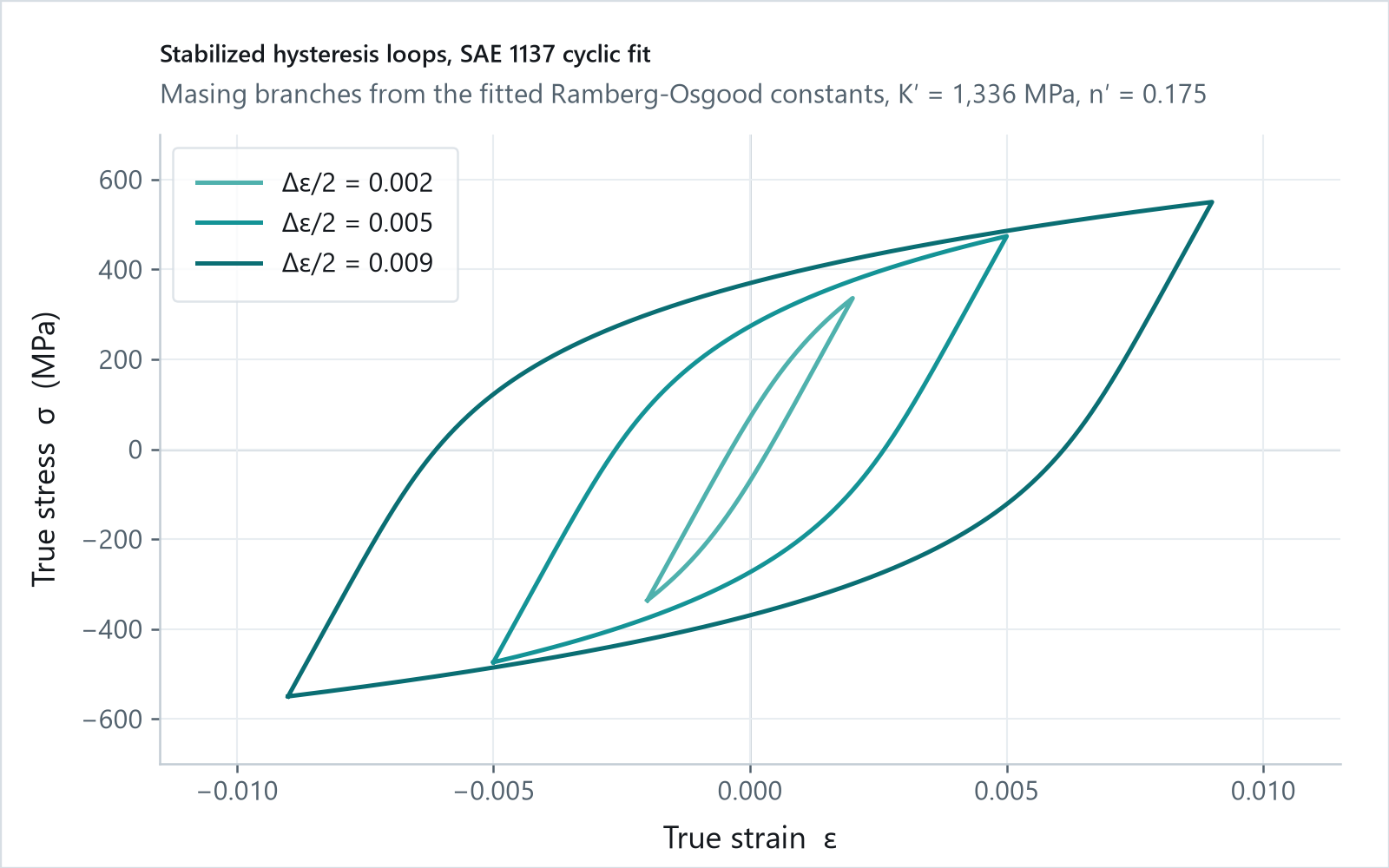
The library produces both figures on this page from the six published SAE 1137 tests used in the tutorial.
- Install, then walk the usage examples or the SAE 1137 tutorial, which reproduces a published dataset end to end.
- PyPI package, source on GitHub, archived releases with DOI 10.5281/zenodo.21222820.
What it covers
| Area | Capability |
|---|---|
| Ingestion | Machine CSV and lab exports, batch series, engineering to true conversion |
| Cycle reduction | Turning points, per-cycle metrics, hysteresis energy, half-life reduction |
| Strain-life | Basquin, Coffin-Manson, Ramberg-Osgood fits, transition life, Masing check |
| Energy-based life | Halford-Morrow energy-life fit and prediction, Masing-loop plastic energy estimate |
| Mean stress | Morrow, modified Morrow, SWT, Walker |
| Variable amplitude | ASTM E1049 rainflow with preserved indices, local-strain simulation with material memory |
| Cumulative damage | Palmgren-Miner, Double Linear Damage Rule, Corten-Dolan |
| Notch | Neuber and Glinka local strain, Kt, Kf, notch sensitivity |
| Statistics | E739-style regression, confidence and prediction intervals, Owen design curves, censored maximum likelihood with lognormal or Weibull scatter, profile-likelihood design bounds, outlier screening, staircase, random fatigue limit |
| Elevated temperature | Frequency-modified Coffin-Manson, time-fraction creep-fatigue, D-diagram |
| Cyclic evolution | Mean stress relaxation and ratcheting power laws |
| Multiaxial | Critical-plane parameters and tensor plane search |
| Interchange | Versioned open formats for constants, test records, and collections, with JSON Schemas |
| Interfaces | Python library, 44 MCP tools, no-code Streamlit GUI |
The open data effort
The toolkit defines and validates open interchange formats for strain-life data, ships a citable seed collection, and accepts contributions. The goal is a FAIR, redistributable strain-life dataset with per-cycle evolution, something no open fatigue database currently provides.
Statistics after E739
ASTM E739 was withdrawn in 2024. Alongside the classical linearized methods the toolkit implements the maximum-likelihood layer its replacement effort points to: censored fits that keep runouts, uncertainty on every estimate, and profile-likelihood design bounds. The statistics page explains what changed and why it matters.
Conventions, fixed
True stress and true strain everywhere. Stress in MPa, strain as a
dimensionless fraction, life in reversals, exponents b and c negative.
Every method traces to a citable source, see the
physics review and the get_citations tool.
Honesty policy
Documentation never claims a capability the code lacks, results carry machine-readable warnings, unvalidated paths are labeled, and every equation and dataset cites its source. When something is approximate, the output says so.